Do You Really Need a Revocable Living Trust in Texas?
Estate Planning Should Be Practical — Not Overcomplicated
Learn when a trust makes sense, when it doesn’t, how it compares to a will, and how it affects probate.
One of the most common estate planning questions we hear is:
“Do I actually need a revocable living trust, or is a will enough?”
The honest answer in Texas is: it depends.
Revocable living trusts can be powerful tools — but they are not automatically the right choice for everyone. For many Texans, a properly drafted will, paired with beneficiary designations and basic estate planning, is sufficient. For others, a revocable living trust can save time, money, and stress for their family.
This page explains what a revocable living trust is, when it makes sense in Texas, when it may be unnecessary, and how it compares to probate and wills.
What Is a Revocable Living Trust?
A revocable living trust is a legal document that holds your assets during your lifetime and directs how those assets are managed and distributed after your death.
Revocable means you can change or cancel it at any time while you are alive and competent
Living means it is created during your lifetime
You typically serve as your own trustee
A successor trustee steps in if you die or become incapacitated
Assets properly transferred into the trust are not required to go through probate.
The Real Question: Do You Need One in Texas?
Texas already has one of the simplest probate systems in the country, especially for uncontested estates. That matters.
For many families, probate in Texas is:
That means avoiding probate is not always a compelling reason by itself to create a trust.
👉 Learn more about Texas Probate
👉 Read our Texas Probate Legal Articles
Situations Where a Revocable Living Trust Often Makes Sense
A revocable living trust may be a good fit if you:
Own real estate in multiple states
Want privacy (probate is public; trusts are not)
Have a blended family or complex distribution plan
Want strong incapacity planning without court involvement
Own a business or complex assets
Want to minimize delays even in uncontested situations
In these cases, a trust can simplify administration and reduce the likelihood of disputes.
Situations Where a Trust May Be Overkill
A revocable living trust may not be necessary if you:
Own a home and basic assets only in Texas
Have a straightforward family situation
Are comfortable with Texas probate
Have beneficiaries listed on accounts and policies
Want to minimize upfront legal costs
In many of these situations, a will-based estate plan can work extremely well.
👉 Related reading: Do I Need a Lawyer for Probate in Texas?
Revocable Living Trust vs. Will in Texas
Will = Does not avoid Probate / Revocable Living Trust = Avoids Probate
Will = Public / Revocable Living Trust = Private
Will = Lower Upfront Cost / Revocable Living Trust = Higher Upfront Cost
Will = Limited features for Incapacity Planning / Revocable Living Trust = Stronger features for Incapacity Planning
A trust is not a replacement for a will — even trust-based plans still require a pour-over will.
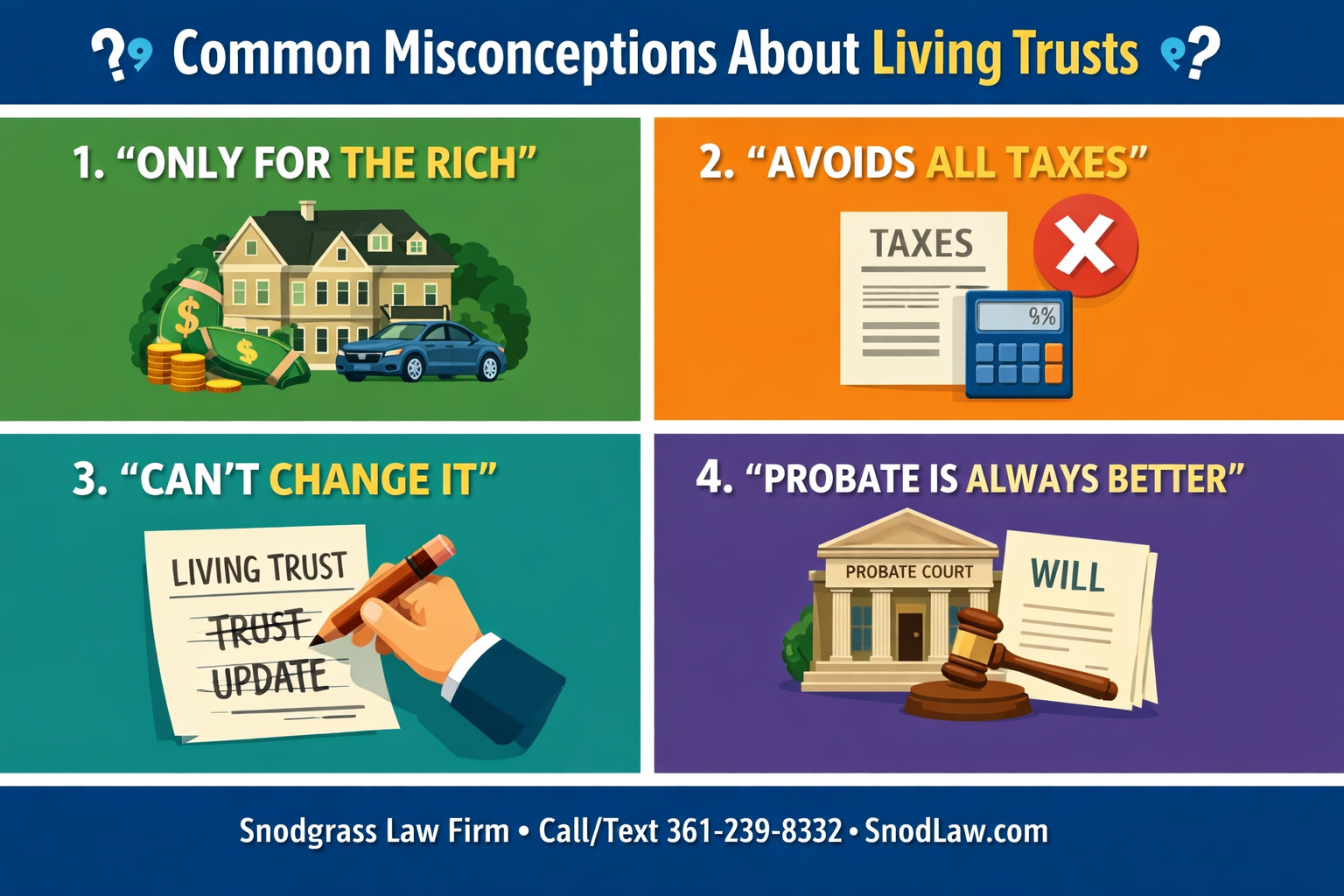
Common Misconceptions About Living Trusts
“Everyone should have one” – Not true in Texas
“It eliminates taxes” – It does not by itself
“It protects assets from creditors” – Generally no
“It’s only for the wealthy” – Also not true
Trusts are tools — not magic solutions.