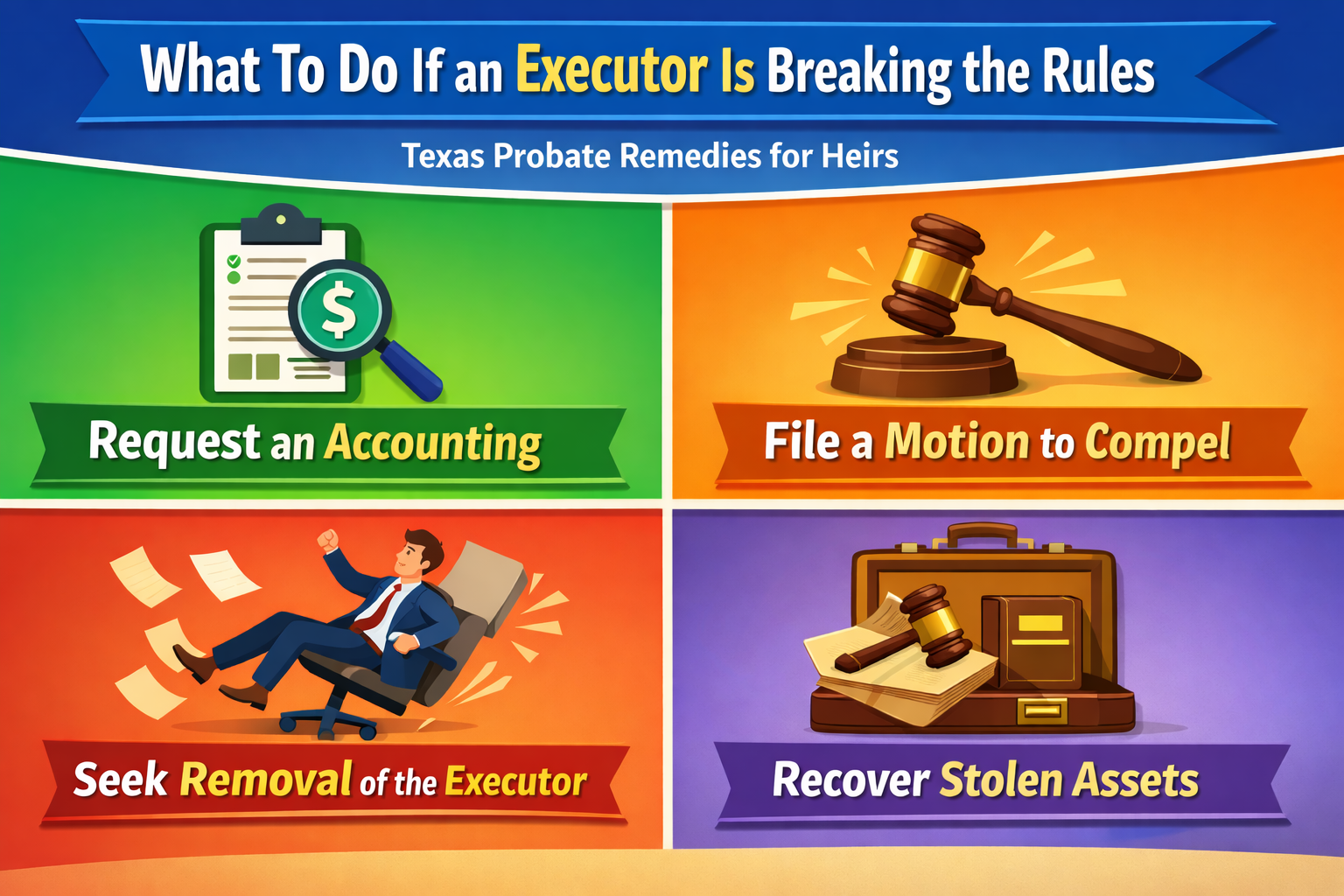
Executor Misconduct:
What an Executor Cannot Do in Texas (And What to Do If an Executor Breaks the Rules)
Probate Rights & Remedies
Learn what an executor is NOT allowed to do under Texas law, common executor misconduct, and what heirs can do to stop it or remove an executor.
What Is an Executor in Texas?
An executor is the person appointed by a Texas probate court to carry out the instructions in a will. Executors owe a fiduciary duty to the estate and its beneficiaries. That means they must act honestly, transparently, and in the best interests of the estate — not themselves.
When an executor violates those duties, Texas law provides remedies for heirs and beneficiaries.
Contact Us • Email • Call • Text
👉 Related reading:
What an Executor Cannot Do in Texas
1. Steal or Take Estate Property
An executor cannot take money, property, or assets for personal use unless the will explicitly allows it. This includes:
Transferring estate funds to personal accounts
Keeping vehicles, jewelry, or firearms
Living in estate property rent-free without authority
🚩 These are some of the most common executor abuses.
2. Ignore Beneficiaries
Executors must keep beneficiaries reasonably informed, including:
Filing required inventories
Responding to legitimate requests for information
Providing accountings when required
Silence, stonewalling, or saying “you’ll get it when you get it” is not acceptable.
3. Delay Probate Without a Reason
Executors cannot sit on an estate indefinitely. Unreasonable delays — especially when no disputes exist — can justify court intervention.
Examples of improper delay:
Waiting years to distribute assets
Failing to close the estate
Blaming “paperwork” without progress
4. Favor One Beneficiary Over Another
Executors must follow the will exactly. They cannot:
Give one heir more than the will allows
Punish a beneficiary they don’t like
“Adjust” distributions for fairness
Personal opinions do not matter — the will does.
5. Sell Property for Less Than Fair Value
Executors must act prudently when selling estate assets. Selling property:
…can be considered self-dealing, even if the executor claims good intentions.
6. Change or Rewrite the Will
Executors have zero authority to modify the will, reinterpret it creatively, or ignore inconvenient provisions.
Only a court can resolve ambiguities.
7. Pay Themselves Excessive Fees
Texas allows reasonable executor compensation — not whatever the executor wants. Excessive or undocumented fees can be challenged and clawed back.
8. Refuse to File an Inventory (Without Court Approval)
Most executors must file an Inventory, Appraisement, and List of Claims unless the court waives it. Refusing to file without approval is improper.
9. Hide Assets
Failing to disclose bank accounts, real estate, or valuable personal property is a serious breach of fiduciary duty.
10. Act Without Court Authority
Executors must stay within the authority granted by:
Acting outside that authority exposes the executor to personal liability.